Printable homeschool worksheets for preschoolers: what to use and how to plan a week
Updated 2026-10-15
Homeschooling a preschooler does not need a big curriculum or hours at a table. At ages 2–6, children learn mostly through play, talk and everyday life. Printable worksheets are a helpful extra: a short, calm activity that builds pencil control, letter and number recognition, and focus. Here is how to choose them and fit them into a gentle week.
What preschoolers actually need to practise
- Fine motor skills: holding a crayon, tracing lines, colouring inside shapes, cutting with child-safe scissors.
- Pre-writing strokes: straight lines, curves, zig-zags and circles come before letters.
- Letters and sounds: recognising letters and their sounds, then tracing them.
- Numbers and counting: counting objects, matching numbers to quantities, tracing 1–10 (then 1–20).
- Vocabulary: naming animals, fruits, vegetables, colours and everyday objects.
- Shapes, colours and patterns: sorting, matching and simple “what comes next?” sequences.
Types of printable worksheets that work well
Tracing worksheets
Start with big dotted lines and shapes, then move to letters and numbers. Look for pages with large letters, clear starting dots and arrows that show the stroke direction. Our Preschool & Kindergarten Workbook follows this order: pre-writing lines, then alphabet and number tracing.
Flashcards and Montessori 3-part cards
Cards are great for short, playful sessions. With Montessori 3-part cards, a child matches a picture to its name card, which grows vocabulary and early reading at the same time. Use them for games like “find the fruit” or a memory match.
Arabic alphabet practice
If your family teaches Arabic or Quran reading, an Arabic alphabet tracing book introduces each letter with tracing and practice space. Remember Arabic is written right to left, so show your child where each letter starts.
Colouring and cutting pages
Colouring builds the hand strength needed for writing. Simple scenes and holiday pages are a fun reward after tracing.
Tips for tracing without tears
- Use a thick crayon or triangular pencil for little hands. It helps with grip.
- Model first. Trace one letter yourself while saying its sound, then let your child try.
- Praise effort, not neatness. Wobbly lines are part of learning.
- Laminate or use sheet protectors so you can reuse the same pages with dry-erase markers.
- Keep sessions short. Two pages done happily beats ten done in tears.
- Add movement. Trace the letter in the air, in sand or with a finger on the table before using paper.
A simple weekly plan for ages 3–5
About 15–20 minutes of “table time” a day is plenty. The rest of the day can be play, stories, outdoor time and helping at home.
- Monday – Letters: introduce one letter and its sound, trace it twice, find three things at home that start with it.
- Tuesday – Numbers: count real objects (spoons, blocks), then trace the number.
- Wednesday – Vocabulary: one set of 3-part cards (e.g. fruits), then a snack with those fruits.
- Thursday – Letters again: review Monday's letter, trace it, colour a picture that starts with it.
- Friday – Fun day: colouring page, cutting practice, or an Arabic letter.
A homeschool planner helps you note what you covered and what your child enjoyed, so planning next week takes five minutes.
Printing tips for worksheets
- Print on normal 80 gsm paper for everyday tracing, and thicker paper for flashcards.
- Print flashcards in colour, and cut them with a paper trimmer for straight edges.
- Print only the pages you need for the week. You can always print more.
- Most families can print as many copies as they need for their own children and classroom.
How to know it's working
Look for small signs: your child points out letters on shop signs, counts the stairs, or asks for “the cards” again. That curiosity matters more than finished worksheets. If your child resists, take a week off and come back with something playful.
Get everything in one download
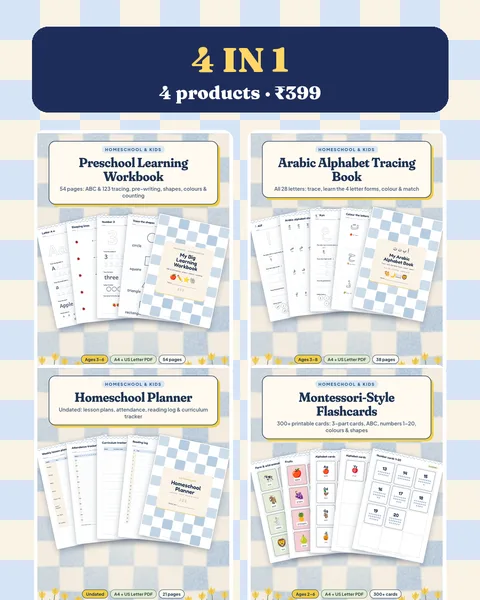
The Homeschool Bundle includes the preschool workbook, Arabic alphabet tracing book, Montessori flashcards and the homeschool planner together, for less than buying them separately.
Questions
At what age can a child start tracing worksheets?
Many children are ready for simple line and shape tracing around age 3, and letter tracing between 3½ and 5. Watch your child: if they hold a crayon comfortably and enjoy it, they are ready. If they get frustrated, go back to play.
How long should a preschool worksheet session be?
Keep it short: 10–15 minutes for ages 3–4 and up to 20 minutes for ages 5–6. Stop while your child is still enjoying it.
How do I reuse worksheets?
Slide the page into a clear sheet protector or laminate it, and use dry-erase markers. Wipe it clean and trace again.
What are Montessori 3-part cards?
Each set has a picture card with its name, a picture card without the name, and a label card. Children match the parts, which builds vocabulary and early reading.
Products in this guide
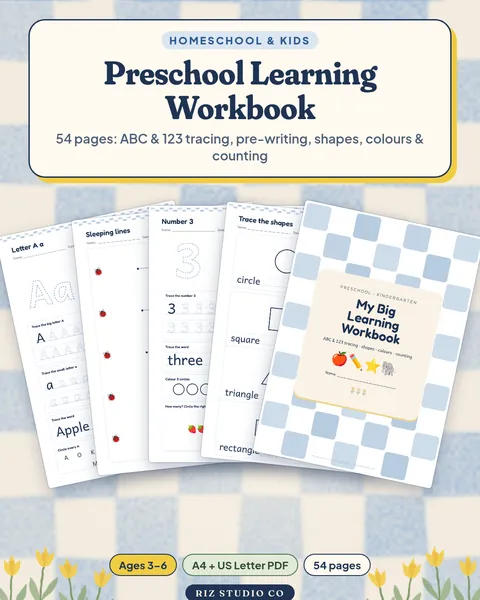
Preschool & Kindergarten Workbook: ABC, 123, Shapes & Colours (54 Pages)
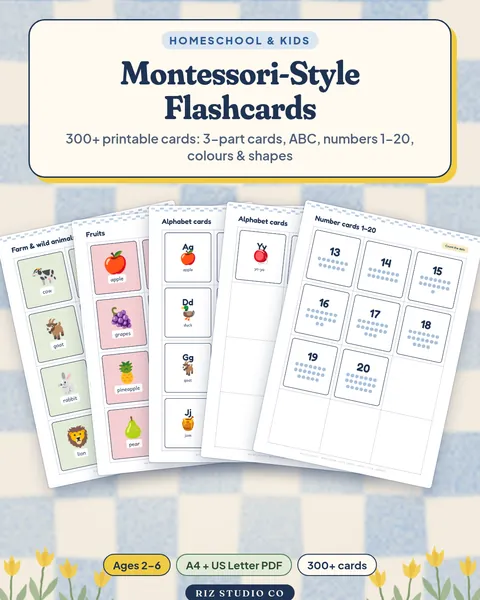
Montessori-Style Flashcards & 3-Part Cards: 300+ Printable Cards
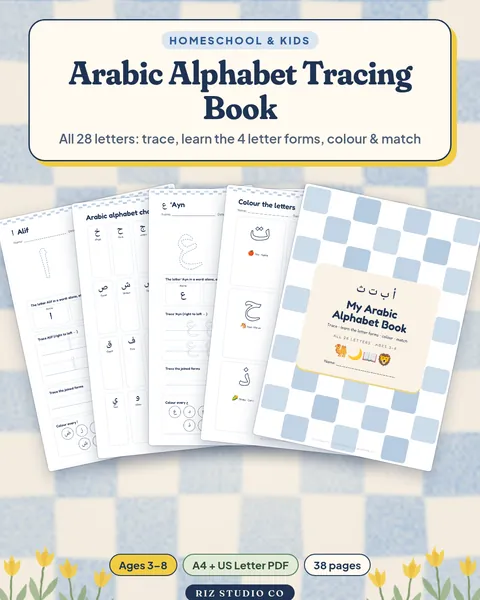
Arabic Alphabet Tracing & Activity Book for Kids (28 Letters)